Case study — E-commerce & Retail
Pre-Launch · Development Complete
Protein Reserve
A more honest way to shop for sports nutrition.
Pre-Launch · Development Complete · PWA · Web
Product strategy, guided discovery UX, commerce systems, authenticity & trust
The problem with supplement retail
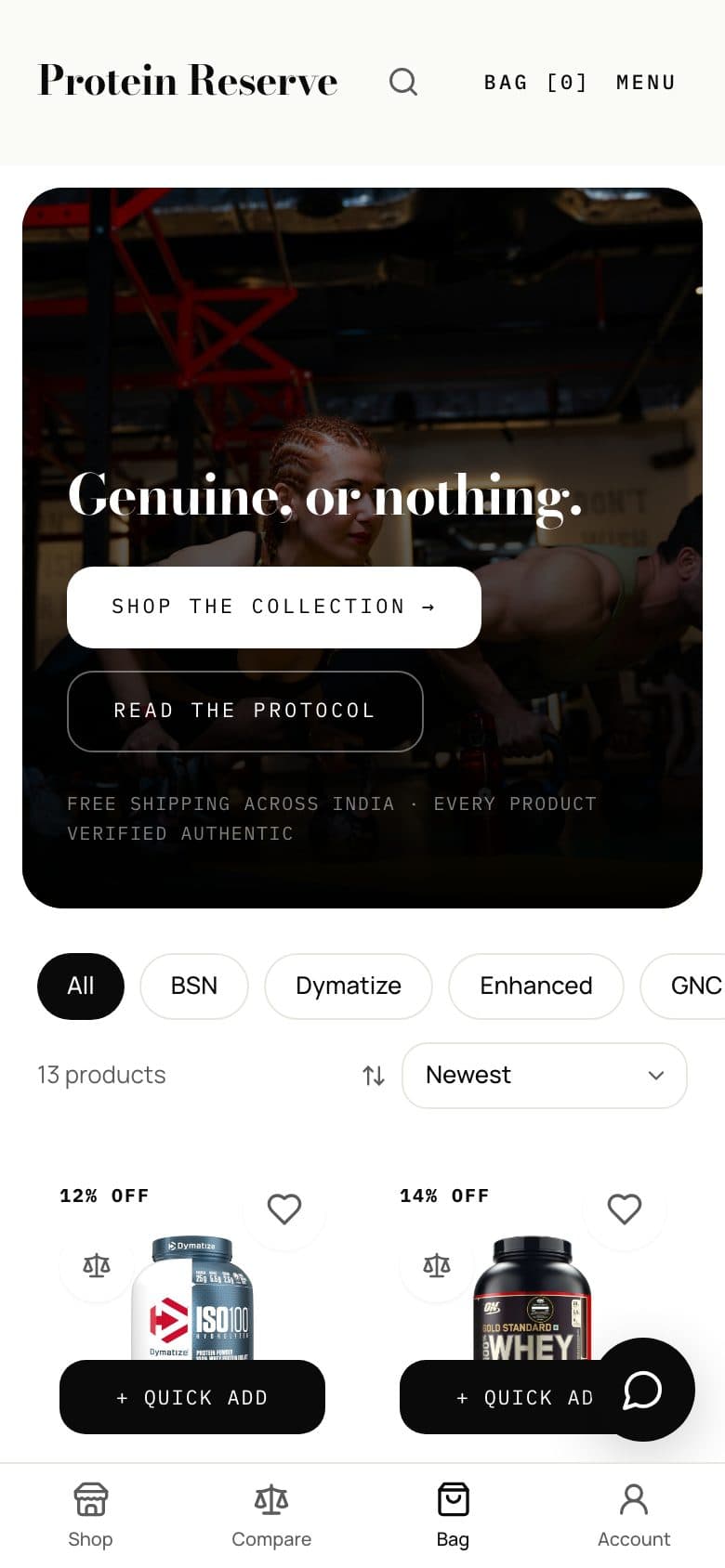
Sports nutrition retail online tends to look the same everywhere: crowded category pages, dozens of near-identical products, and an undertone of doubt about whether what arrives is actually genuine. For a first-time buyer, that's disorienting — too much choice, not enough guidance, and a nagging authenticity question that most stores never address directly. Protein Reserve starts from that observation. Rather than compete by listing more products more loudly, the premise is to make the buying experience calmer and more trustworthy, with ISO100 positioned as the hero product around which the rest of the catalogue and the discovery experience are organized.
Authenticity as the product
The instinct with authenticity concerns is usually to bolt on a trust badge somewhere near checkout. I wanted verification to be the core promise of the store, not a decoration next to it. That means the product experience itself — how items are presented, what's communicated about sourcing and genuineness — is built around addressing the authenticity anxiety head-on rather than hoping a logo quiets it. Verification as the core promise is the organizing idea behind the whole storefront, not a single page or a single component sitting off to the side.
Guided discovery
Choosing a protein or supplement isn't always straightforward, especially for someone newer to the category. The intent behind Protein Reserve's discovery experience is to educate rather than just list: product education, side-by-side comparison, and tools like a protein finder or calculator to help a customer land on the right product for their goals instead of guessing between dozens of similar-looking tubs. These guided-discovery elements are designed and in development as part of the storefront, aimed at replacing generic category browsing with something closer to informed recommendation.
The commerce build
Underneath the storefront is a React and Vite progressive web app backed by Supabase for data and auth, with Razorpay planned as the payment provider once that integration goes live. That's a deliberately ordinary stack choice — the interesting work is in the discovery and trust experience built on top of it, not in the technology underneath, which exists to support checkout, product data, and account handling without getting in the way.
Where it stands
Protein Reserve is Pre-Launch · Development Complete: the core platform and website are developed, and what remains is payment gateway activation and final business and regulatory approvals before public launch. There are no live sales, customers, or market results to report yet — the storefront, the authenticity and verification presentation, and the guided-discovery tools have all been built ahead of that launch, with Razorpay integration the remaining piece of getting checkout live.
Protein Reserve has sharpened how I think about trust as a product problem rather than a marketing one. When a customer's biggest hesitation is authenticity, that hesitation has to be answered by the product itself — how it presents information, how it guides a decision — not patched over with reassuring copy at the end. It's a useful discipline to carry into any e-commerce work: address the real doubt, don't decorate around it.